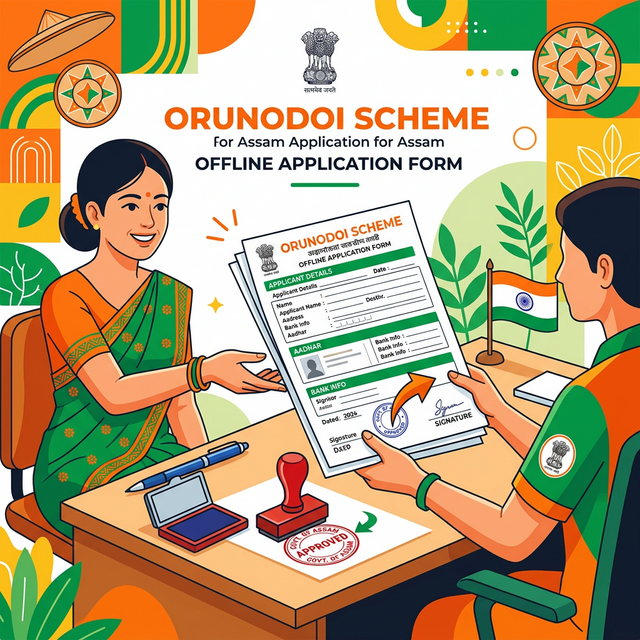
Welcome back! If you want to get your family onto the Orunodoi 3.0 list without wasting weeks running in circles, let us get straight to the point. Over 37 lakh women in Assam get ₹1,250 deposited into their bank accounts on the 10th of every month. But here is the plain truth that cyber cafes will not tell you: there is zero online apply link. If someone tells you to "click here to register online" or asks for ₹300 at a shop, they are taking you for a ride. The state government only accepts real paper forms handed in at your local Gaon Panchayat or town ward office. We spent time walking into Panchayat offices across Kamrup, Nagaon, and Dibrugarh to see how forms actually get approved. Here is our completely honest, step-by-step walkthrough.
📋 Orunodoi 3.0 Application Snapshot (2026)
| How to Apply: | 100% Offline (Local Gaon Panchayat / Ward Office) |
|---|---|
| Cost of Form: | ₹0 (Completely Free — never pay anyone) |
| Monthly Support: | ₹1,250 / Month (Credited on 10th via DBT) |
| The Non-Negotiable: | Bank account must have Aadhaar DBT enabled |
| Official State Portal: | assam.gov.in ↗ |
What is the Orunodoi 3.0 scheme in Assam?
Orunodoi 3.0 is Assam's direct cash-support program that sends ₹1,250 every month straight into the Aadhaar-linked bank account of a family's female head on the 10th. Applications run entirely offline through free serialized paper forms collected from local Gaon Panchayats or Municipal Ward offices.
Think of Orunodoi as steady monthly support for the family kitchen and medicines. The money goes straight to the mother of the house because she manages daily groceries, school supplies, and medical needs. The best part? No cash in hand, no local leaders taking a cut, and zero middleman fees. The money hits your bank account straight from the state treasury.
And just to be crystal clear: if someone sends you a WhatsApp link promising an "approved Orunodoi PDF download" or asks for an OTP to check your list, block them on the spot. The state prints each form with a unique barcoded serial number that belongs to your local block. A random download from the internet is worth less than scrap paper.
Who qualifies and who gets turned down immediately?
To qualify for Orunodoi 3.0, you must live permanently in Assam, earn under ₹2 Lakhs a year, hold an active ration card, and have an Aadhaar-seeded bank account. Families with government staff, four-wheelers, ACs, or over 15 Bighas of farmland are rejected automatically.
The rules sound long, but they boil down to common sense. The government wants this money to reach families who genuinely struggle to buy groceries at the end of the month. You can also read through our breakdown on Orunodoi eligibility criteria if you want the full background.
Eligible Groups Given High Priority:
- Widows, single mothers, and unmarried women managing a household alone.
- Families where the main breadwinner has a permanent physical disability.
- Households holding an active NFSA ration card with yearly earnings under ₹2 Lakhs.
- Families living in non-pucca homes identified during local village surveys.
Strict Exclusion List (Automatic Rejection):
- Anyone in the family working a government job — permanent or on contract — or drawing a pension.
- Any family owning a car, tractor, or commercial tempo. (Two-wheelers and scooters are fine).
- Homes with an air conditioner installed.
- Families holding more than 15 Bighas of agricultural farming land.
- Households with any current or past political officeholders (MLAs or MPs).
📝 The 4 Steps from Paper Pickup to Stamped Receipt
| What Step | Where to Go / What to Do | Important Advice to Remember |
|---|---|---|
| 1. Picking up the form | Walk into your local Gaon Panchayat or town Ward Office. | Check that the paper has an official pre-printed serial number. Never accept photocopies from xerox shops. |
| 2. Writing your details | Fill in all boxes slowly in neat capital letters using a blue or black pen. | Copy your 11-digit IFSC code directly from your bank book. Double check every digit. |
| 3. Adding your papers | Staple your four xerox copies behind the main form. | Sign your name or press your inked thumbprint at the bottom of every single page. |
| 4. Turning it in | Hand the papers straight to your Panchayat Secretary and wait for your slip. | Never leave without the torn-off receipt stamped with the purple office seal and date. |
How do you apply for Orunodoi 3.0 offline?
To apply for Orunodoi 3.0 offline, pick up a free serialized form from your Gaon Panchayat or Municipal Ward office, fill in your banking details in capital letters, attach self-attested photocopies of your Aadhaar, bank passbook, and ration card, then collect your signed acknowledgment receipt.
Follow these four practical steps carefully to avoid getting your paper held up at the block desk:
Step 1: Pick up the official paper form (Never photocopy)
Walk straight into your Gaon Panchayat office if you live in a village, or your Municipal Ward office if you live in town. Ask the Panchayat Secretary for an Orunodoi 3.0 form. Look at the top corner — it has to have an official pre-printed serial number. If a local shop gives you a photocopied sheet, do not touch it. The scanning machines at the block office reject photocopies immediately. And remember: this form is 100% free. If anyone asks for ₹50 or ₹100 "printing fee," walk away.
Step 2: Fill out your banking details letter-by-letter
Sit at a table with a plain blue or black ballpoint pen and write in clean capital letters. Take your time here because banking errors kill more applications than anything else. Look at your passbook and write down the 11-digit IFSC code without mixing up numbers and letters — a zero is not the letter 'O'. Also, if your bank got merged (like United Bank into PNB, or Allahabad Bank into Indian Bank), pull your new IFSC from the branch before writing it down. Your name on this form must match your Aadhaar card and passbook down to the exact spelling.
Step 3: Gather your four paper copies
You don't need a giant folder of papers. You only need four basic xerox copies. Make sure every copy is clear and readable, and sign your name or press your inked thumbprint at the bottom of each sheet. Take a look at our Orunodoi document checklist if you want full details:
First, get a clean photocopy of both sides of the mother's Aadhaar card. Second, make a sharp copy of the front page of your bank passbook where your name, account number, and 11-digit IFSC code are clearly printed. Third, xerox your family's active ration card showing the names of your household members. And fourth, include an income certificate from your local Circle Officer showing that your household earns less than ₹2 Lakhs a year. That is all you need.
Step 4: Hand in the bundle and get your stamped slip
Staple your documents behind the form and hand the bundle directly to the Panchayat Secretary or ward officer. Don't just leave it on a table and walk out. Watch them tear off the bottom acknowledgment strip, stamp it with the purple office seal, sign it with a date, and hand it to you. That little slip of paper is your only proof that you applied. Take it home and keep it inside your ration card folder.
🔗 Read Also: Orunodoi Help & Verified Guides
What happens after you hand in your papers?
After submission, block data operators type your paper form into the state portal. Local verification teams visit homes to confirm family income and living conditions. Once the district committee clears your name, ₹1,250 credits to your Aadhaar-linked bank account on the 10th of each month.
Don't expect instant SMS notifications the next day. The block operator takes anywhere from two to four weeks to enter your details into the system. After that, a village verification team (usually the Gaon Pradhan along with local teachers or VLEs) might do a quick spot-check at your home to make sure your living conditions match your paperwork. Once the district committee gives the green light, your bank account connects to the system, and your credit alert arrives on the 10th.
FAQ:-
How do you make sure your bank account actually gets the ₹1,250?
Your account must be linked for Aadhaar Direct Benefit Transfer through NPCI. Just linking your Aadhaar for KYC is not enough. Walk into your bank branch and ask the clerk: "Please make sure my Aadhaar NPCI DBT mapping is active." If this mapping is missing, the money bounces back to the government.
What should you do if your Gaon Panchayat runs out of forms?
Panchayats get forms in fixed batches from the block office. If they run out, do not buy copies from a xerox shop. The computer scanners at the block reject photocopies. Wait a few days for the next official batch to arrive, or visit your local BDO office desk directly.
Can two women from the same ration card apply?
No. The rule is strictly one payment per ration card. If two women from the same family submit separate forms, the computer catches the duplicate ration card number and puts both on hold.
What is the real phone number to call if your application gets stuck?
Call the official toll-free helpline at 1800-202-6256 between 10 AM and 6 PM, Monday through Saturday. The staff speak Assamese, Bengali, and English, and can look up your file using your stamped receipt number.
Have a question about your Panchayat form, bank IFSC, or Aadhaar DBT? Drop your query in the comments below or head over to your local Gaon Panchayat office — we track ground updates across Assam every single week to keep you protected from scams!